
Attention Dysregulation
At our Raynham, MA clinic
Focus, attention, and brain-fog issues affecting work and quality of life.
Attention, focus, and mental clarity depend on adequate oxygen delivery, healthy cerebral blood flow, and a nervous system that isn't stuck in overdrive. When breathing is restricted, blood flow is compromised, or metabolic inflammation is high, the brain's ability to sustain focus drops — regardless of intelligence, motivation, or effort. This is not a diagnosis of ADHD; it's a physiological look at why focus is failing.
Understanding attention dysregulation
Focus, regulation, and the physiology behind them.
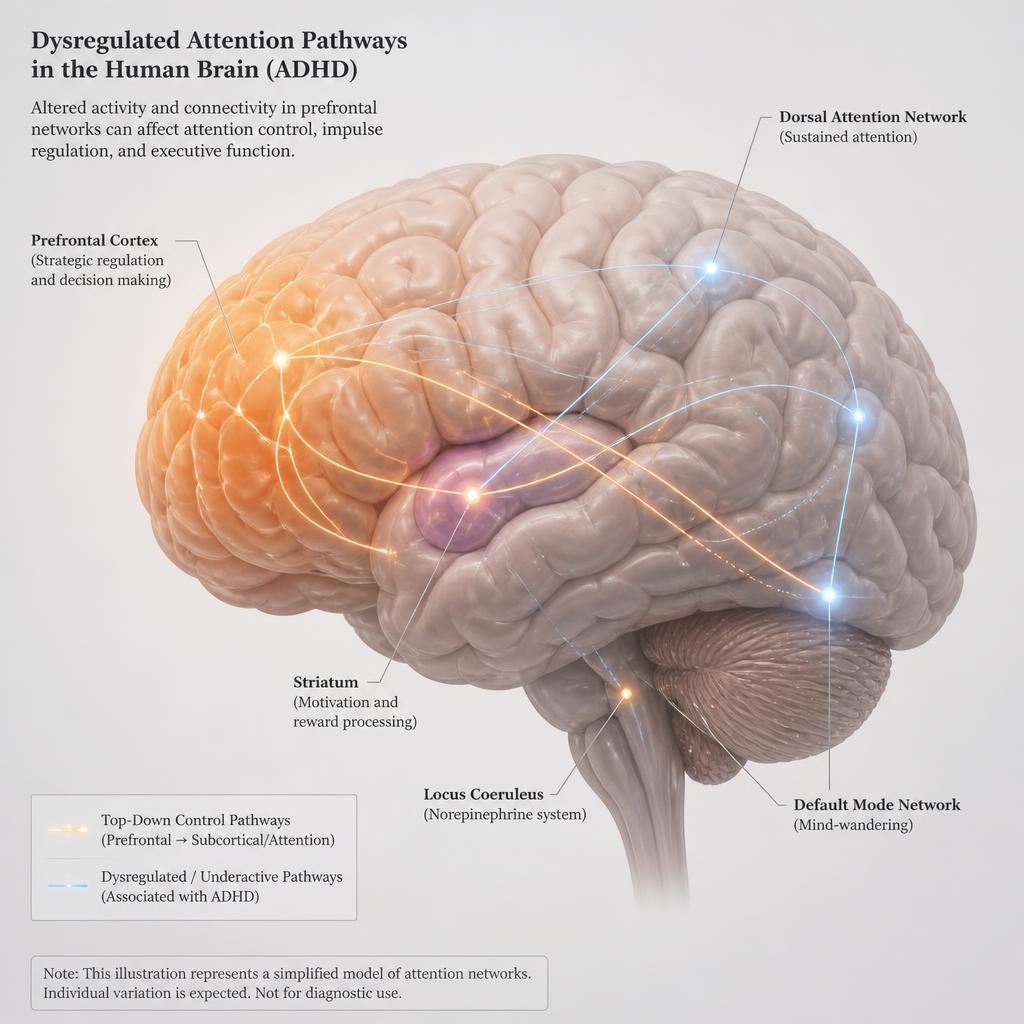
Attention is a whole-body process. Prefrontal networks that govern focus and executive function depend on stable blood sugar, healthy circulation, quality sleep, and a well-functioning nervous system. When any of those inputs are off — poor oxygenation, cervical dysfunction, metabolic imbalance — attention and self-regulation suffer. At Regenerative Medicine of Raynham, we look for the physical contributors and use tools like PEMF, EWOT, cervical care, and metabolic support to help patients feel more grounded and clear-headed.
Quick summary
What you'll learn
- How chronic mouth-breathing quietly starves the brain of oxygen
- The link between cervical spine dysfunction and cognitive fog
- Why blood sugar swings feel like an attention problem
- How EWOT and CFR support focus without stimulants
- What labs actually help identify metabolic drivers
If this sounds like you
The daily struggles patients with attention dysregulation tell us about.
Symptoms we see
- Difficulty sustaining focus on tasks
- Mental fog or slow processing
- Restlessness, irritability, or sleep disruption
- Brain fatigue after meals or screens
What may be causing it
- Restricted nasal breathing and chronic low oxygen
- Cervical spine dysfunction affecting brain blood flow
- Metabolic inflammation and blood sugar swings
- Sleep apnea or undiagnosed breathing disorders
Risk factors
What raises the likelihood.
- Chronic nasal congestion or mouth breathing
- Untreated sleep apnea or heavy snoring
- Concussion history or repeated head impacts
- Insulin resistance or metabolic syndrome
- High occupational cognitive load without recovery
How we approach it
A plan tailored to your case.
- 1
Breathing assessment and Cranial Facial Release (CFR)
- 2
Exercise With Oxygen Therapy (EWOT) to improve cerebral oxygenation
- 3
Cervical spine care to optimize blood flow
- 4
Targeted lab work to surface metabolic contributors
Our approach
Comprehensive care aimed at the root cause — not just the symptoms.
- Look at breathing and blood flow before assuming a psychiatric issue
- Use CFR to restore nasal airway function
- Use EWOT to improve oxygen delivery and mitochondrial output
- Fix cervical spine restrictions that limit brain blood flow
- Rule in — or out — metabolic and sleep drivers with real labs
Candidacy
Who may be a candidate
- Adults with chronic brain fog and low focus
- Post-concussion recovery
- Executives and professionals with cognitive fatigue
- Patients wanting stimulant-free options
- Anyone with breathing or sleep quality concerns
Therapies we may recommend
Advanced, state-of-the-art therapies for lasting relief.
Cranial Facial Release (CFR)
Endo-nasal balloon technique to mobilize cranial bones and open the nasal airway.
ExploreExercise With Oxygen Therapy (EWOT)
Exercising on high-flow oxygen to improve mitochondrial performance and recovery.
ExploreLab Testing
Comprehensive lab panels to surface metabolic, hormonal, and nutritional drivers.
ExplorePEMF Therapy
Pulsed electromagnetic field therapy to support cellular repair and reduce pain.
ExploreCondition-specific answers
Questions about attention dysregulation
Answers to what patients most often ask about attention dysregulation and how we approach it. Don't see yours? Call us — we're happy to talk it through.
Honest answers
Common questions about regenerative medicine
The broader questions patients ask before scheduling — efficacy, safety, candidacy, longevity, and cost. Answered openly.
Go deeper
Still have doubts about regenerative medicine?
Read our full honest answer — including why most doctors don't offer it, how it compares to surgery and cortisone, and why patients choose us.
Serving southeastern Massachusetts
Nearby towns we serve for attention dysregulation.
Patients travel to our Raynham office from across Bristol, Plymouth, and Norfolk counties. Get directions and local details for your town below.
Raynham, MA
0–5 min from our Raynham office via South Street West / Route 138
Taunton, MA
10–15 min from our Raynham office via Route 138 north or Route 44 west
Bridgewater, MA
10–15 min from our Raynham office via Route 104 east / Route 24
Middleborough, MA
15–25 min from our Raynham office via Route 44 west or Route 105 to Route 44
Easton, MA
15–20 min from our Raynham office via Route 138 north or Route 106
Ready to start?
Talk to us about your attention dysregulation
Talk through your goals, your imaging, and what regenerative medicine can — and can't — do for you. Honest answers, no pressure.