
Thumb Arthritis (CMC)
At our Raynham, MA clinic
Basal joint (CMC) thumb arthritis — small-joint PRP and non-surgical care.
Thumb basal-joint arthritis affects the CMC joint at the base of your thumb — the one you use every time you pinch or grip. It's one of the most common osteoarthritis sites in the hand. Small-joint PRP, splinting, and targeted rehab often postpone or replace the need for surgery.
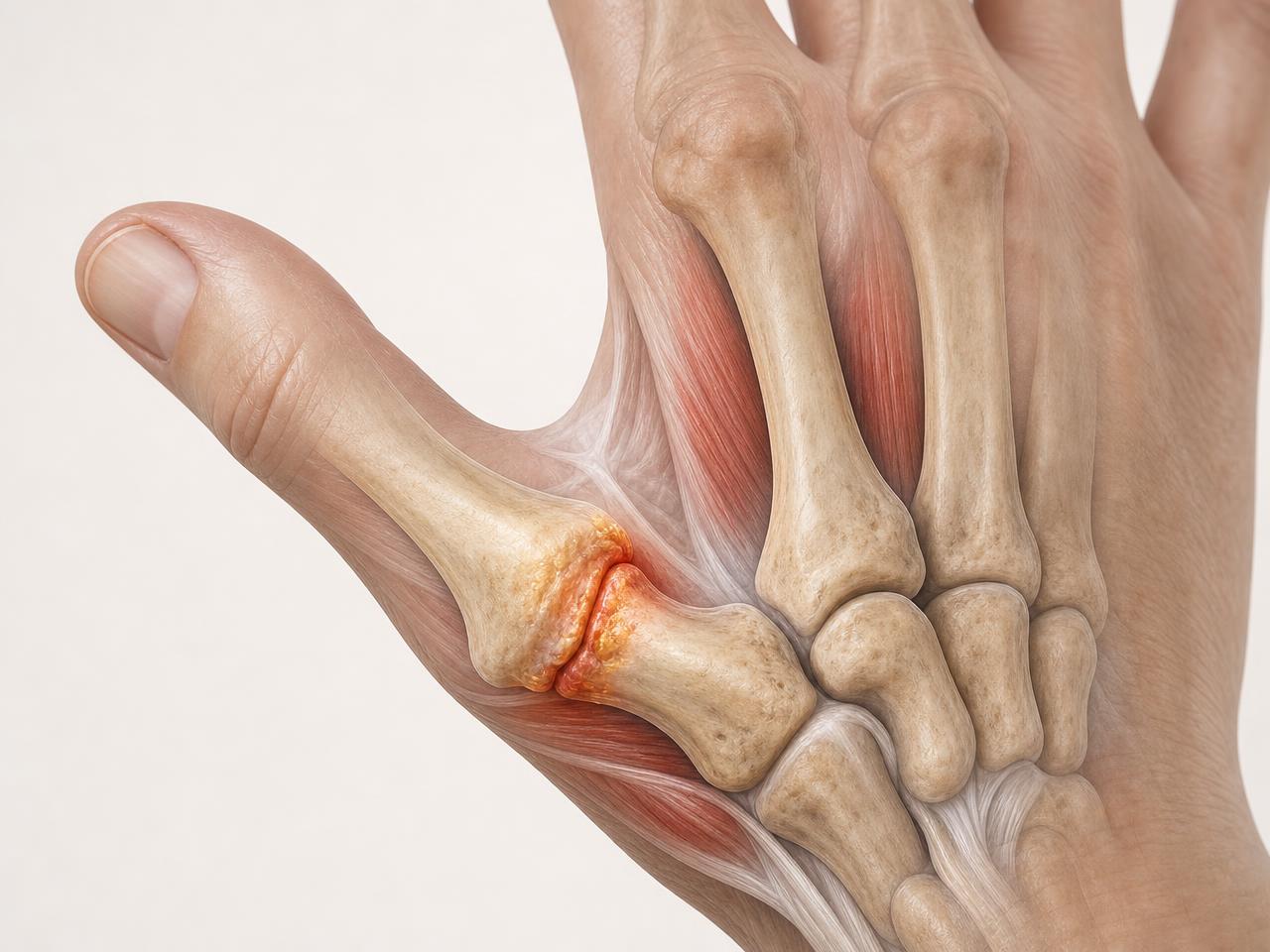
Understanding thumb arthritis
The CMC joint at the base of the thumb is one of the hardest-working joints in the hand.
Thumb arthritis, also called basal-joint or CMC arthritis, affects the carpometacarpal joint where the thumb meets the wrist. Every pinch, grip, twist, and lift passes stress through this small saddle-shaped joint. Over time, the cartilage thins and the joint surfaces become rough, causing pain at the base of the thumb, weakness with fine motor tasks, and visible squaring of the joint. Because the thumb accounts for roughly 40% of hand function, CMC arthritis can disrupt everything from opening jars to writing. At Regenerative Medicine of Raynham, we use detailed hand exam, small-joint PRP, and targeted rehab to reduce pain and restore grip without rushing to surgery.
Quick summary
What you'll learn
- Why the CMC joint wears out so commonly
- How small-joint PRP works
- The role of splinting and hand therapy
- When surgery makes sense
If this sounds like you
The daily struggles patients with thumb arthritis (cmc) tell us about.
Symptoms we see
- Pain at the base of the thumb
- Pain with pinching or gripping
- Visible squaring of the CMC joint
- Weakness with fine motor tasks
What may be causing it
- Cumulative CMC joint wear
- Genetic predisposition (more common in women 40+)
- Prior thumb injury
How we approach it
A plan tailored to your case.
- 1
Detailed thumb and hand exam
- 2
Small-joint PRP
- 3
Custom splinting and hand therapy
- 4
Adjunctive laser or PEMF
Candidacy
Who may be a candidate
- Mild-to-moderate CMC arthritis
- Patients wanting to avoid trapeziectomy
- Post-splint failures
Therapies we may recommend
Advanced, state-of-the-art therapies for lasting relief.
PRP (Platelet-Rich Plasma)
Concentrated platelets and growth factors to support tendon, ligament, and joint healing.
ExploreLaser Therapy
Class IV photobiomodulation to reduce pain and accelerate tissue healing.
ExplorePEMF Therapy
Pulsed electromagnetic field therapy to support cellular repair and reduce pain.
ExploreCondition-specific answers
Questions about thumb arthritis (cmc)
Answers to what patients most often ask about thumb arthritis (cmc) and how we approach it. Don't see yours? Call us — we're happy to talk it through.
Honest answers
Common questions about regenerative medicine
The broader questions patients ask before scheduling — efficacy, safety, candidacy, longevity, and cost. Answered openly.
Go deeper
Still have doubts about regenerative medicine?
Read our full honest answer — including why most doctors don't offer it, how it compares to surgery and cortisone, and why patients choose us.
Serving southeastern Massachusetts
Nearby towns we serve for thumb arthritis (cmc).
Patients travel to our Raynham office from across Bristol, Plymouth, and Norfolk counties. Get directions and local details for your town below.
Raynham, MA
0–5 min from our Raynham office via South Street West / Route 138
Taunton, MA
10–15 min from our Raynham office via Route 138 north or Route 44 west
Bridgewater, MA
10–15 min from our Raynham office via Route 104 east / Route 24
Middleborough, MA
15–25 min from our Raynham office via Route 44 west or Route 105 to Route 44
Easton, MA
15–20 min from our Raynham office via Route 138 north or Route 106
Ready to start?
Talk to us about your thumb arthritis (cmc)
Talk through your goals, your imaging, and what regenerative medicine can — and can't — do for you. Honest answers, no pressure.