
Plantar Fasciitis
At our Raynham, MA clinic
Chronic heel and foot pain — shockwave and PRP for the plantar fascia.
Plantar fasciitis is degeneration of the thick band of tissue running along the bottom of your foot. Despite the '-itis' name, the process is more degenerative than inflammatory — which is why cortisone alone rarely delivers a lasting solution. Shockwave therapy and PRP directly address the tissue quality of the fascia itself.
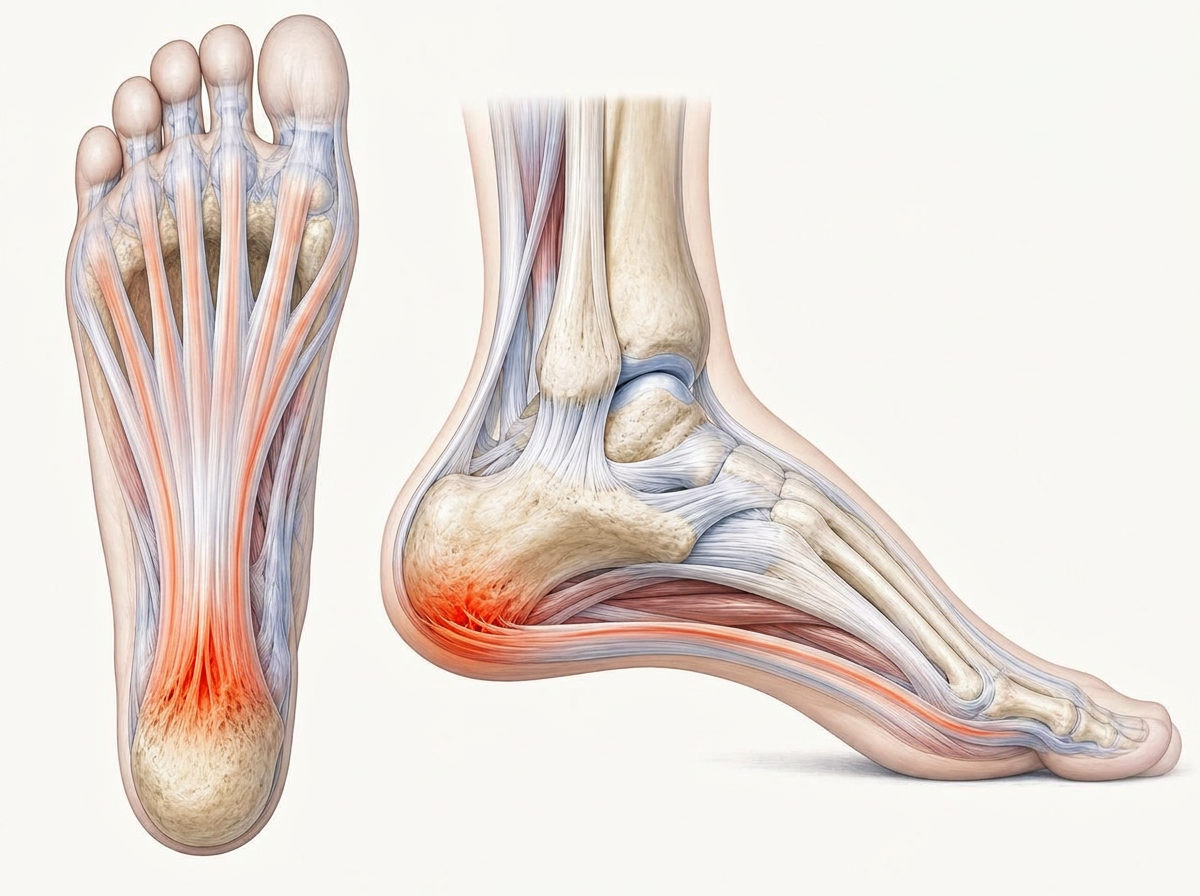
Understanding plantar fasciitis
A strong band under strain, usually starting at the heel.
The plantar fascia is a thick band of tissue that runs from the heel to the toes and supports the arch of the foot. Pain develops when this band is repeatedly overstretched or overloaded, leading to micro-irritation where it attaches to the heel bone. Classic symptoms include sharp heel pain with the first steps in the morning or after sitting. At Regenerative Medicine of Raynham, we look at foot mechanics, calf and ankle tension, and the local tissue environment to choose the regenerative or conservative therapy most likely to calm the inflammation and support healing.
Quick summary
What you'll learn
- Why cortisone alone often fails long-term
- How shockwave therapy stimulates fascia repair
- The role of PRP for chronic plantar fasciitis
- Rehab and footwear strategies that actually help
- Realistic recovery timelines
If this sounds like you
The daily struggles patients with plantar fasciitis tell us about.
Symptoms we see
- Sharp heel pain with first steps of the day
- Pain after long standing or walking
- Tenderness along the arch and heel
- Stiffness after rest
What may be causing it
- Chronic overload of the plantar fascia
- Weak intrinsic foot muscles
- Calf tightness and poor ankle mobility
- Sudden increase in training or work-hours-on-feet
How we approach it
A plan tailored to your case.
- 1
Detailed foot and gait exam
- 2
Shockwave therapy for degenerative fascia
- 3
PRP injections for chronic cases
- 4
Rehab, footwear, and load management
Candidacy
Who may be a candidate
- Chronic plantar fasciitis (>3 months)
- Failed conservative care (orthotics, NSAIDs, PT)
- Prior cortisone with limited durable relief
Therapies we may recommend
Advanced, state-of-the-art therapies for lasting relief.
Shockwave Therapy
Acoustic-wave therapy that stimulates healing in chronic tendons and soft tissue.
ExplorePRP (Platelet-Rich Plasma)
Concentrated platelets and growth factors to support tendon, ligament, and joint healing.
ExploreLaser Therapy
Class IV photobiomodulation to reduce pain and accelerate tissue healing.
ExplorePEMF Therapy
Pulsed electromagnetic field therapy to support cellular repair and reduce pain.
ExploreCondition-specific answers
Questions about plantar fasciitis
Answers to what patients most often ask about plantar fasciitis and how we approach it. Don't see yours? Call us — we're happy to talk it through.
Honest answers
Common questions about regenerative medicine
The broader questions patients ask before scheduling — efficacy, safety, candidacy, longevity, and cost. Answered openly.
Go deeper
Still have doubts about regenerative medicine?
Read our full honest answer — including why most doctors don't offer it, how it compares to surgery and cortisone, and why patients choose us.
Serving southeastern Massachusetts
Nearby towns we serve for plantar fasciitis.
Patients travel to our Raynham office from across Bristol, Plymouth, and Norfolk counties. Get directions and local details for your town below.
Raynham, MA
0–5 min from our Raynham office via South Street West / Route 138
Taunton, MA
10–15 min from our Raynham office via Route 138 north or Route 44 west
Bridgewater, MA
10–15 min from our Raynham office via Route 104 east / Route 24
Middleborough, MA
15–25 min from our Raynham office via Route 44 west or Route 105 to Route 44
Easton, MA
15–20 min from our Raynham office via Route 138 north or Route 106
Ready to start?
Talk to us about your plantar fasciitis
Talk through your goals, your imaging, and what regenerative medicine can — and can't — do for you. Honest answers, no pressure.