Herniated Disc
At our Raynham, MA clinic
Bulging and herniated discs — non-surgical decompression and regenerative care.
A herniated disc happens when the soft inner nucleus pushes through the tougher outer ring of the disc, sometimes pressing on a nerve. Most herniated discs never need surgery — the disc can shrink and the nerve can calm down when we take pressure off it and give the tissue a chance to heal.
Understanding herniated disc
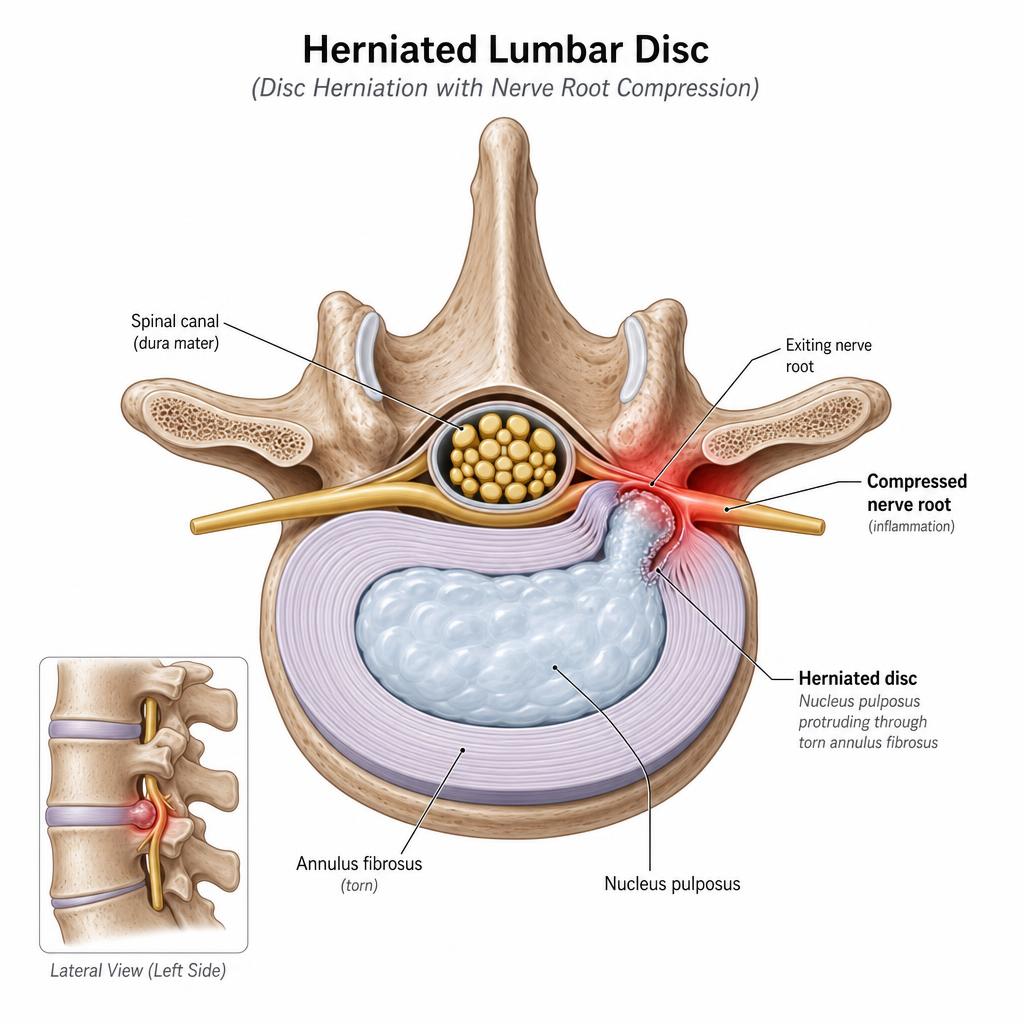
A tear in the outer ring lets the inner nucleus press on a nerve.
A herniated disc occurs when the soft nucleus pulposus inside an intervertebral disc pushes through a tear in the tougher annulus fibrosus. If that material touches or inflames a nearby nerve root, it can produce sharp, radiating pain, numbness, tingling, or weakness in the arm or leg. Herniations are most common in the lumbar and cervical spine. At Regenerative Medicine of Raynham, we correlate your symptoms with imaging, use non-surgical spinal decompression to reduce pressure on the disc, and add laser, PEMF, and targeted rehab to calm nerve inflammation and support long-term stability.
Quick summary
What you'll learn
- The difference between a bulging and a herniated disc
- How non-surgical spinal decompression actually works
- Why most herniations resolve without surgery
- The signs that mean you do need a surgeon
If this sounds like you
The daily struggles patients with herniated disc tell us about.
Symptoms we see
- Radiating pain into arm or leg
- Numbness or tingling in a nerve distribution
- Weakness in the affected limb
- Pain worse with sitting or forward bending
What may be causing it
- Age-related disc degeneration
- Sudden lifting or twisting injury
- Repetitive loading
- Prior spine injury
Traditional options
Common treatments — what they do and don't do.
NSAIDs and muscle relaxers
Symptom control only.
Epidural injections
Bridge care during acute flares.
Microdiscectomy
Effective for the right patient; carries risks and revision rate.
How we approach it
A plan tailored to your case.
- 1
Neurologic exam and imaging review
- 2
Non-surgical spinal decompression
- 3
Laser therapy for nerve inflammation
- 4
PEMF for tissue recovery
- 5
Rehab for core and postural stability
Candidacy
Who may be a candidate
- Disc herniation without severe weakness or bladder issues
- Patients trying to avoid or delay spine surgery
- Post-surgical patients with residual disc symptoms
Your care journey
What treatment typically looks like.
Week 1
Exam, imaging review, and decompression protocol design.
Weeks 1–5
Decompression 2–3× weekly with adjunctive laser.
Weeks 5–10
Add stabilizing rehab; taper decompression frequency.
Months 3+
Maintenance to keep the disc healthy long-term.
Therapies we may recommend
Advanced, state-of-the-art therapies for lasting relief.
Condition-specific answers
Questions about herniated disc
Answers to what patients most often ask about herniated disc and how we approach it. Don't see yours? Call us — we're happy to talk it through.
Honest answers
Common questions about regenerative medicine
The broader questions patients ask before scheduling — efficacy, safety, candidacy, longevity, and cost. Answered openly.
Go deeper
Still have doubts about regenerative medicine?
Read our full honest answer — including why most doctors don't offer it, how it compares to surgery and cortisone, and why patients choose us.
Serving southeastern Massachusetts
Nearby towns we serve for herniated disc.
Patients travel to our Raynham office from across Bristol, Plymouth, and Norfolk counties. Get directions and local details for your town below.
Raynham, MA
0–5 min from our Raynham office via South Street West / Route 138
Taunton, MA
10–15 min from our Raynham office via Route 138 north or Route 44 west
Bridgewater, MA
10–15 min from our Raynham office via Route 104 east / Route 24
Middleborough, MA
15–25 min from our Raynham office via Route 44 west or Route 105 to Route 44
Easton, MA
15–20 min from our Raynham office via Route 138 north or Route 106
Ready to start?
Talk to us about your herniated disc
Talk through your goals, your imaging, and what regenerative medicine can — and can't — do for you. Honest answers, no pressure.